The colony did not rebel against tea. It rebelled against the bill.
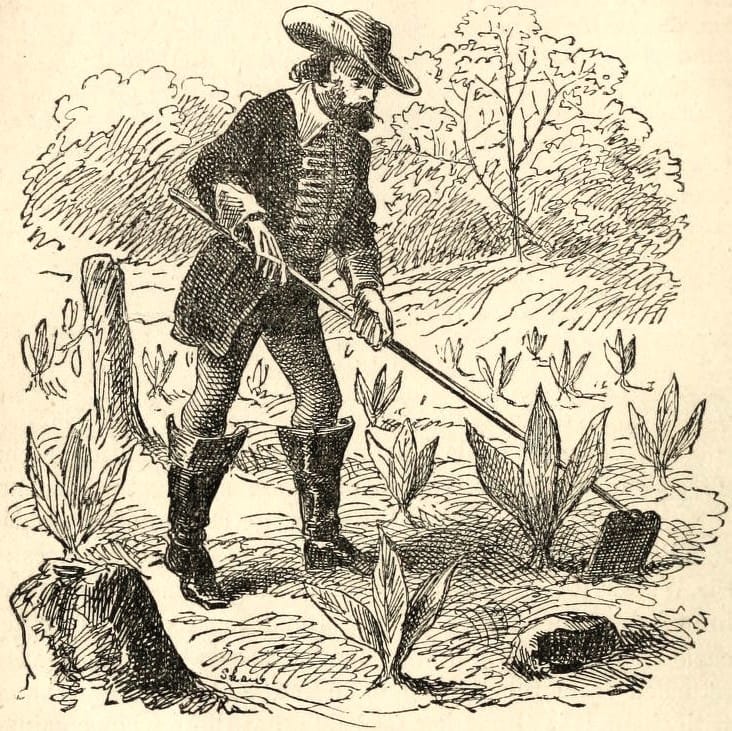
Samuel Hobbes — not his real name, but his real life — stands on Griffin's Wharf on the night of December 16, 1773, watching men he recognizes dump 342 chests of East India Company tea into Boston Harbor. He is a rope maker. He earns roughly £40 a year. He has never owned stock in anything. The men throwing crates into the black water are not aristocrats. They are tradesmen, apprentices, dockworkers — people whose wages have been squeezed by import monopolies they never voted on and cannot escape. Samuel does not cheer. He watches. He understands, without a word of economic theory, exactly what is happening: someone far away has decided what he must pay, and to whom, and he has no voice in that decision.
He will die never knowing the country he helped build that night.
THE MOMENT
The harbor smells of salt and low tide. It is a Thursday. By 6 p.m. the meeting at Old South Meeting House has collapsed — Governor Hutchinson has refused to send the ships back to England without paying the duty. Roughly 5,000 colonists, nearly a third of Boston's entire population, pack the hall and overflow into the streets. When organizer Samuel Adams declares, "This meeting can do nothing more to save the country," it functions less as a speech and more as a signal.
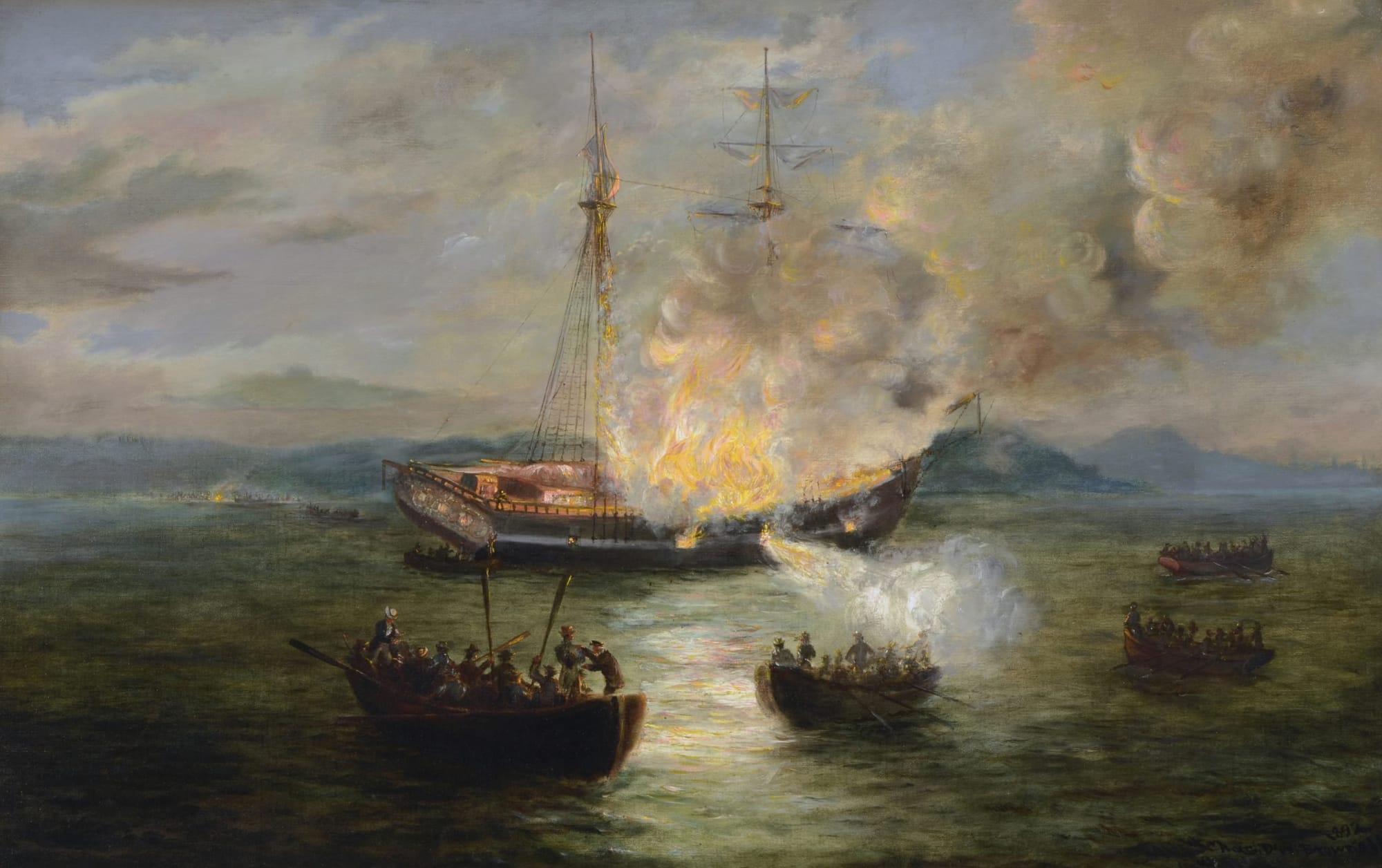
Within twenty minutes, somewhere between 116 and 130 men, some dressed as Mohawk warriors, board three ships — the Dartmouth, the Eleanor, the Beaver — and spend three hours systematically destroying 342 chests of Bohea, Congou, Souchong, Singlo, and Hyson tea. The street value: £10,000. Adjusted conservatively for colonial purchasing power, that is roughly $1.7 million in 2026 dollars, per estimates cited by the Economic History Association at eh.net.
They damage nothing else. They sweep the decks afterward. One man caught pocketing tea is stripped and sent home. This is not a riot. It is a targeted economic action.
THE BIRTH
The Tea Act of 1773 was not designed to raise taxes. It was designed to save a corporation.
The British East India Company — one of history's earliest examples of a government-backed monopoly — held 17 million pounds of unsold tea rotting in London warehouses. Parliament granted it the right to sell directly to American colonists, cutting out local merchants entirely, and kept a small Townshend duty in place — not for revenue, but to assert the principle that Parliament could tax the colonies without their consent.
The price of tea actually dropped. That was the trap. London calculated the colonists would swallow the principle to save money on their morning cup.
They miscalculated because they did not understand what they were really taxing. They were not taxing tea. They were taxing the right to self-governance, and Americans had already decided that right was not for sale at any price.
Local merchants like John Hancock — who had made his fortune in smuggled Dutch tea — understood the threat immediately. A government-sponsored monopoly that could undercut free traders today could control any market tomorrow. The Tea Act was not just a tariff. It was a template.
THE EMOTION
The farmer in Concord hears about Boston and feels something he does not have a name for yet. It is not patriotism — that word barely exists in its modern form. It is closer to economic vertigo: the sensation that the rules of the market he operates in are being rewritten by someone who will never feel the consequences.
The merchant's wife in Philadelphia calculates the household ledger and understands that this is not about three pence per pound. It is about whether the price she pays for anything is subject to her consent.
The dockworker in New York — who loads and unloads under terms set in London — registers that the East India Company's protected route could eventually replace him entirely.
No one reads a pamphlet and converts. They feel the squeeze first. The politics follow the pocketbook.
THE CAUSE (The Chain)
The chain runs clean and fast.
Parliament passes the Tea Act, May 1773 → East India Company ships 600,000 pounds of tea toward American ports → Colonial merchants face elimination → Committees of Correspondence coordinate resistance across 13 colonies → Boston takes direct action, December 16 → Parliament passes the Coercive Acts, March 1774, closing Boston Harbor and suspending Massachusetts self-government → Colonial economies begin coordinated boycott, trade collapses → First Continental Congress convenes, September 1774 → Economic interdependence among colonies becomes political interdependence → Revolutionary War, 1775.
The destruction of £10,000 in tea triggers a sequence that costs Britain its most productive colonial economy. The East India Company, which Parliament tried to rescue, never recovers its American market. It begins its long collapse, finally dissolved by the British government in 1874 — a monopoly that overreached and lost everything.
The mechanism is always the same: concentrated economic power, imposed without accountability, generates resistance proportional not to the cost but to the principle.
THE IMPACT TODAY
The Tea Party embedded one idea so deeply into American economic DNA that it survives every administration: taxation without representation is not a political complaint. It is a breach of contract.
That contract shapes everything from the structure of the Federal Reserve — a body Congress created precisely because it did not trust unaccountable financial power — to the enforcement actions the Fed issued this week against the Bank of Eufaula and SNB Bancshares, small community banks now held accountable under a regulatory framework that traces its legitimacy directly to 1773. The principle is unchanged: no financial actor, however powerful, operates outside a system of public accountability.
The law still on the books is the Constitution's Taxing and Spending Clause — Article I, Section 8. The habit still practiced is every November ballot. The institution still operating is Congress itself, born from the argument that began on that wharf.
Most Americans cannot locate the Tea Act in a timeline. They practice its consequences every time they demand to know what they are paying and why.
THE IMPACT TOMORROW
The Tea Party did not resolve the tension between economic power and democratic consent. It named it.
That tension is 2026's central economic argument: platform monopolies setting terms of trade for millions of small sellers. Healthcare pricing structures that function like colonial tariffs — imposed, opaque, unavoidable. Financial products marketed to people who have no practical alternative and no meaningful voice in their design.
The question Boston asked in 1773 — who has the right to set the price — arrives in 2076 inside algorithms. The people who feel the squeeze first will still be the ones without equity, without access, and without a seat at the table where the rates are set. The form changes. The mechanism does not.
THE HUMAN IT TOUCHED
She lives in Baltimore in 1791. She runs a small dry-goods stall and buys her tea now from an American importer, at a market price set by competition rather than crown charter. She has never heard of the Tea Act. She does not know that men on a Boston dock eighteen years earlier destroyed cargo so that no government could permanently hand her supplier's market to a preferred corporation.
She pays what the market asks. She considers this normal.
She has no idea it was a choice someone made for her — violently, deliberately, and at serious personal risk — so that the price on her shelf would belong to the market and not to a monopoly.
That is the part history forgets: freedom of commerce did not arrive naturally. Someone paid for it first.
Back on Griffin's Wharf, Samuel Hobbes watches the last chest hit the water. The harbor smells like tea now, the tannins sharp in the cold December air. He turns and walks home. He does not feel like a revolutionary. He feels like a man who has spent his whole life being told what things cost, by people who will never pay the price themselves.
America has been having that argument ever since.
Sources: Economic History Association, eh.net; U.S. National Archives, archives.gov (Tea Act primary documents); Library of Congress/Congress.gov (Constitution, Article I, Section 8); Federal Reserve enforcement actions, federalreserve.gov, June 2025. Tea cargo valuation methodology per EHA colonial price indices.
WALLPOST · wallpost.org · America, through money.
© 2026 WALLPOST. All rights reserved.