In 2022, the European Union fined Apple €1.8 billion for restricting Spotify's access to its iOS payment ecosystem. The regulatory argument was elegant: a dominant platform owner was weaponizing its proprietary architecture to suppress market competition.
In 1612, an English entrepreneur named John Rolfe executed the structural inverse. He did not protect a monopoly; he dismantled one. He did it by violating the most fiercely guarded intellectual property regime of the 17th-century Atlantic world.
What Rolfe smuggled was a seed. What he engineered was the first Anglo-American cash-crop monoculture—establishing an institutional and economic path dependency that would govern the next 250 years of Southern capitalism. The critical question for economic history is not the ethics of the theft, but the structural allocation of its downstream costs.
I. THE MONOPOLY THAT SPAIN BUILT
By 1612, the Virginia Company of London operated on the precipice of structural insolvency. The enterprise had sunk over £60,000 into the Jamestown venture with negligible return on investment. The indigenous tobacco variety—Nicotiana rustica, cultivated by the Powhatan Confederacy—was harsh, bitter, and unmarketable to European consumers accustomed to premium imports.
The Spanish Empire held a lucrative, vertically integrated monopoly on the premium tobacco market. Their West Indian strain, Nicotiana tabacum, was smooth, sweet, and commanded exorbitant prices across European ports.
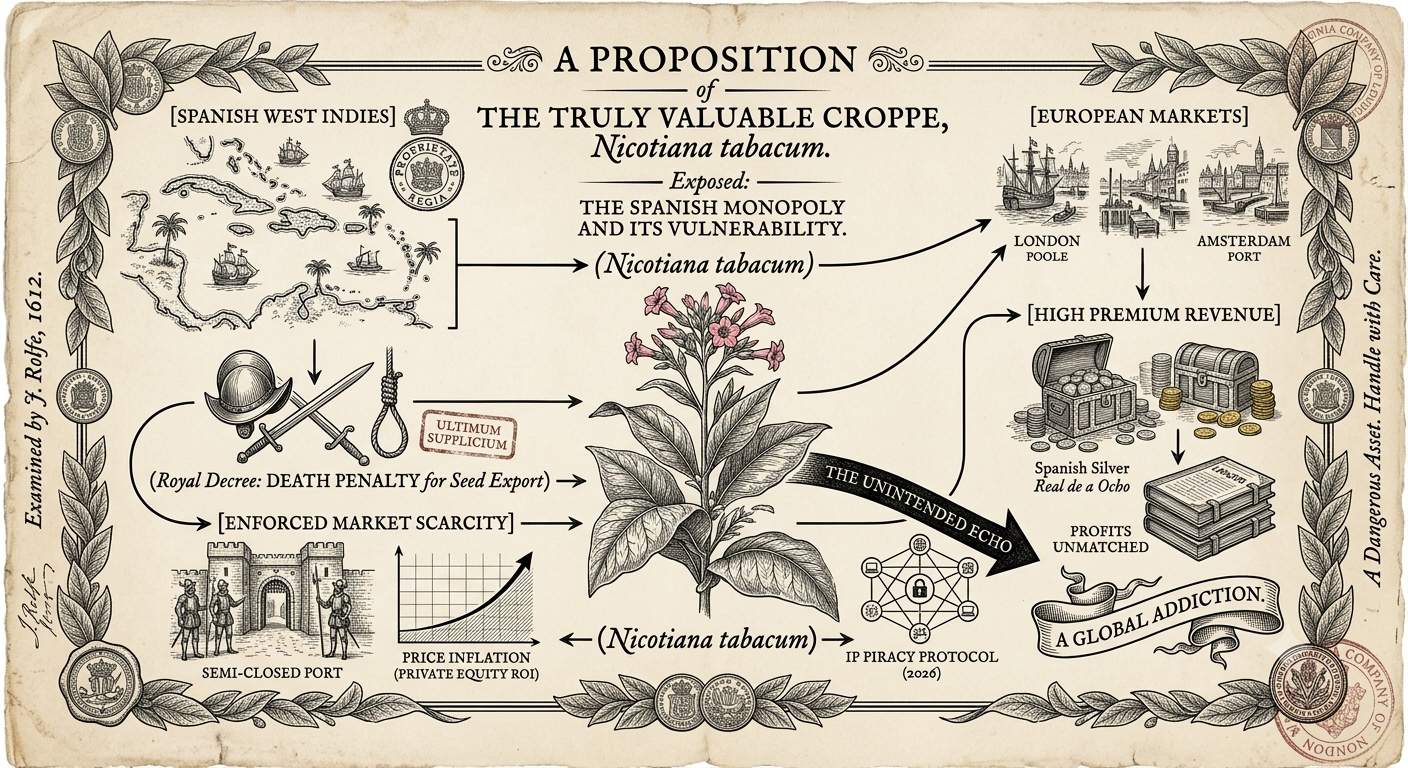
Madrid protected this agricultural asset with the full apparatus of imperial law. Under royal decrees dating back to the early colonial administration, the unauthorized export of Nicotiana tabacum seeds to foreign nationals was classified as a capital crime against the Crown. The penalty was not asset forfeiture; it was execution at the gallows. Spain treated the seed as a state-controlled technology. Control the biological raw material, control the global supply chain.
The Virginia Company understood this protectionist calculus. Rolfe’s subsequent acquisition of the seed was not an isolated act of farming; it was a targeted corporate operation designed to break an empirical trade barrier.
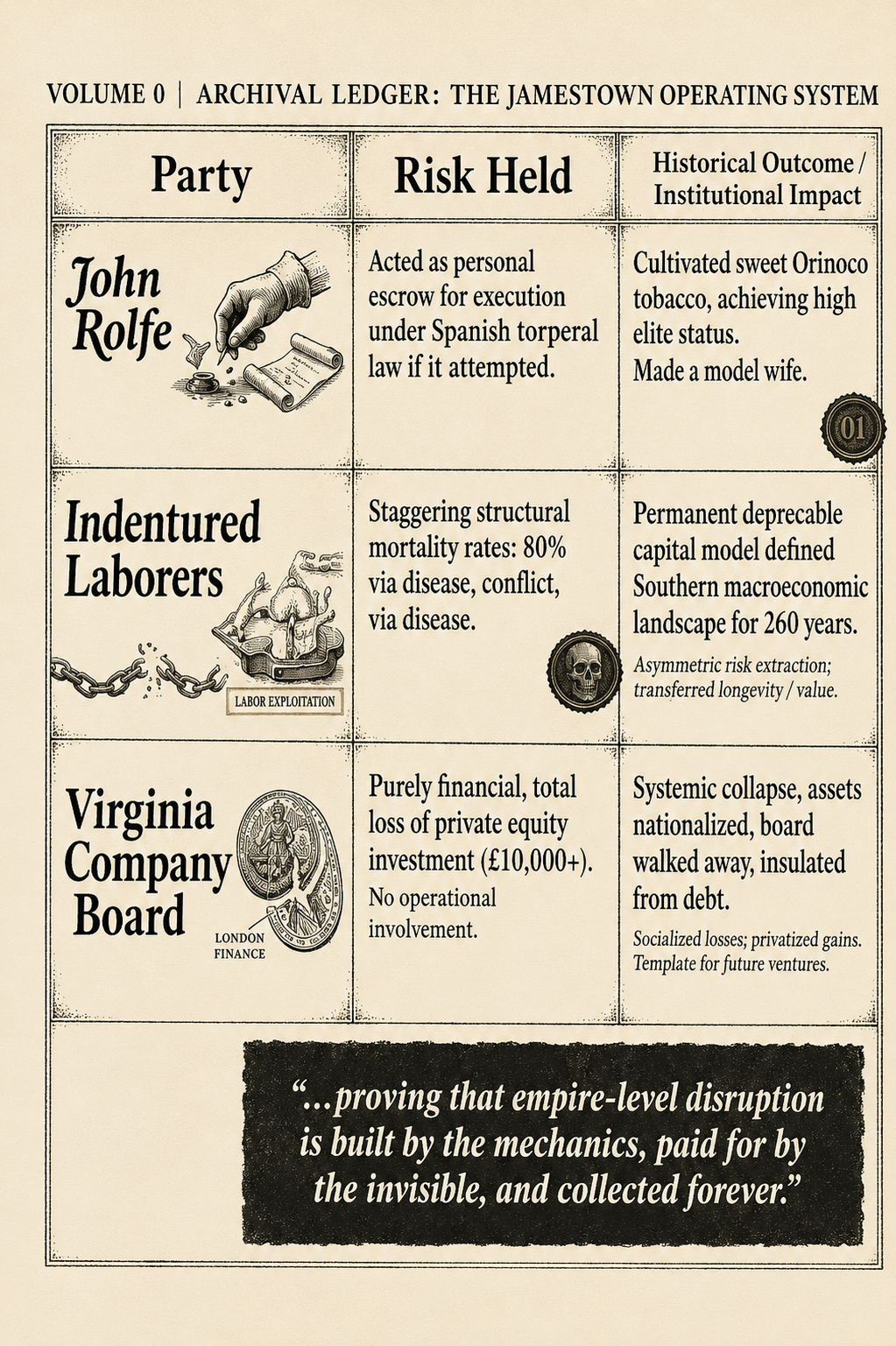
II. THE RISK TRANSFER MATRIX
The immediate dividends of Rolfe’s exploit accrued to English corporate interests, while the long-term systemic liabilities were externalized onto non-consenting populations.
III. THE BOTANICAL MECHANISM AND LAND EXTRACTION
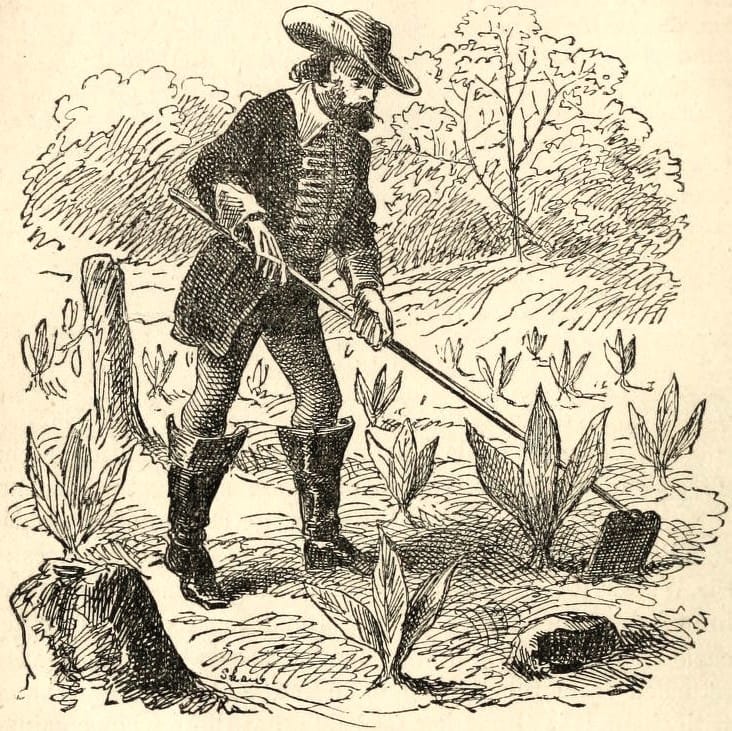
Rolfe smuggled a cache of Nicotiana tabacum seeds out of the Spanish Caribbean—likely Trinidad or Venezuela—during his transit via Bermuda between 1609 and 1610. He planted the first experimental crop in the brackish, nitrogen-rich soil of the James River basin. The biological compatibility of the Caribbean seed with the Virginia climate surpassed the company's internal projections.
The institutional transformation was rapid, as documented in colonial shipping manifests:
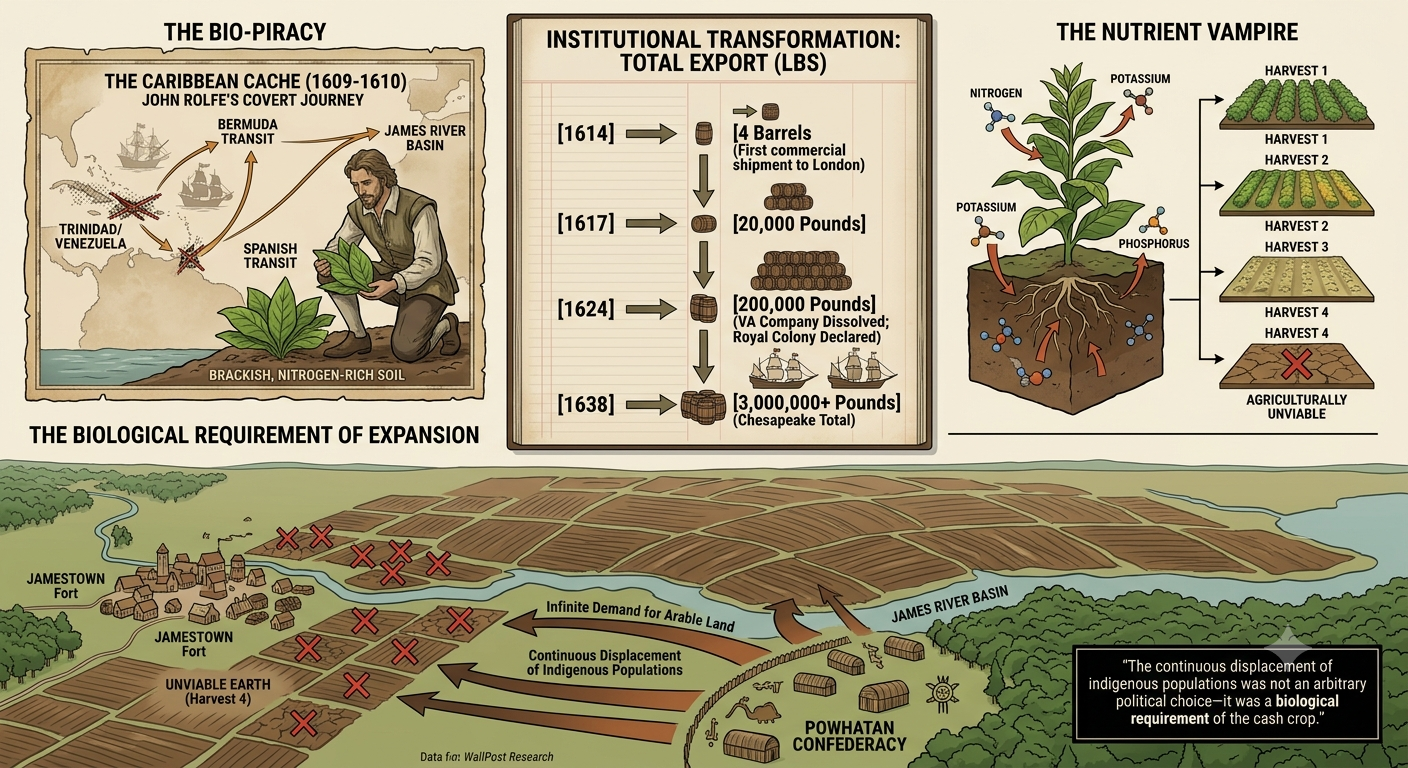
This exponential growth curve concealed a structural agricultural flaw: Nicotiana tabacum is an aggressive nutrient consumer. The plant rapidly depletes essential nitrogen, potassium, and phosphorus from the topsoil, rendering fields agriculturally unviable after three to four consecutive harvests.
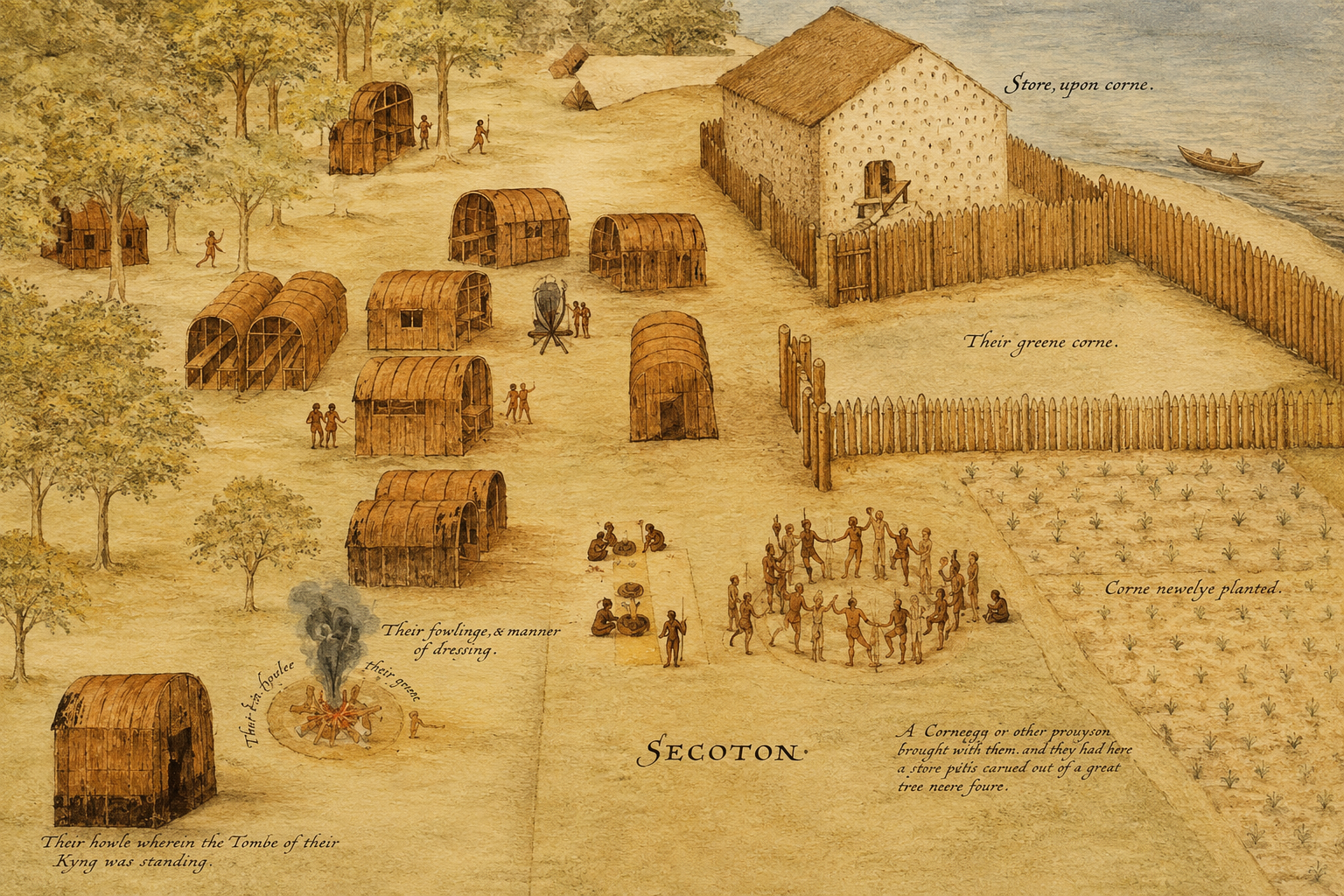
Because fertilizer technology was primitive and land-to-labor ratios favored extraction over conservation, the Virginia economy required an infinite supply of arable land. The crop dictated the geography. More tobacco required more acreage; more acreage required geographical expansion into the alluvial ridges occupied by the Powhatan Confederacy. The continuous displacement of indigenous populations was not an arbitrary political choice—it was a biological requirement of the cash crop.
IV. THE EVOLUTION OF THE LABOR CONSTRAINTS
The argument that Rolfe's seed instantly created institutional chattel slavery in 1619 misreads the economic transition. The true trajectory reveals a more complex, chilling economic calculation: a long-term pivot driven by shifts in demographic supply curves and capital depreciation.
Phase 1: The Indentured Labor Era (1610s–1670s)
Initially, the Virginia planter class met the intense labor demands of tobacco—which required meticulous hand-planting, weeding, topping, and curing—through the exploitation of white English indentured servants. As economic historian Russell Menard notes, throughout the mid-17th century, indentured labor remained cheaper than purchasing enslaved labor, despite catastrophic mortality rates where nearly 50% of servants died before completing their terms.
Phase 2: The 1619 Spark vs. The 1670s Pivot
In late August 1619, the White Lion, a privateer flying a Dutch flag, landed at Point Comfort and traded "20 and odd" Angolans captured from a Spanish slave ship (San Juan Bautista) for provisions. While this marks the tragic entry of African labor into the colony, legal and tax records show these individuals were initially integrated into an ambiguous labor structure akin to life-term servitude.
The systemic transition to a race-based chattel slave economy occurred decades later, around the 1670s. As white life expectancy improved in Virginia, buying an indentured servant's limited contract became less economically rational than investing higher upfront capital into a lifetime of enslaved labor. Combined with a drop in English immigration rates, the planter class codified race-based slavery into law (e.g., Virginia Slave Codes of 1705) to guarantee a permanent, self-reproducing labor force for the monoculture.
The stolen seed did not create chattel slavery in a single day; it created a structural labor deficit that made the eventual institutionalization of slavery the most profitable economic solution for the planter elite.
V. THE PHILOSOPHICAL CLAIM
The economic architecture built by Rolfe’s theft exposes a profound paradox at the heart of Western property law. In his Second Treatise of Government (1689), John Locke articulated the foundational labor theory of value:
"Whatsoever then he removes out of the state that nature hath provided, and left it in, he hath mixed his labor with, and joined to it something that is his own, and thereby makes it his property."
— John Locke, Second Treatise of Government, Chapter V
By Locke's framework, when Rolfe mixed English labor with the Virginia soil to cultivate tobacco, the resulting commodity became legitimate private property—independent of Spain's sovereign claim over the initial genetic material. The theft of the raw material did not invalidate the legal ownership of the output.
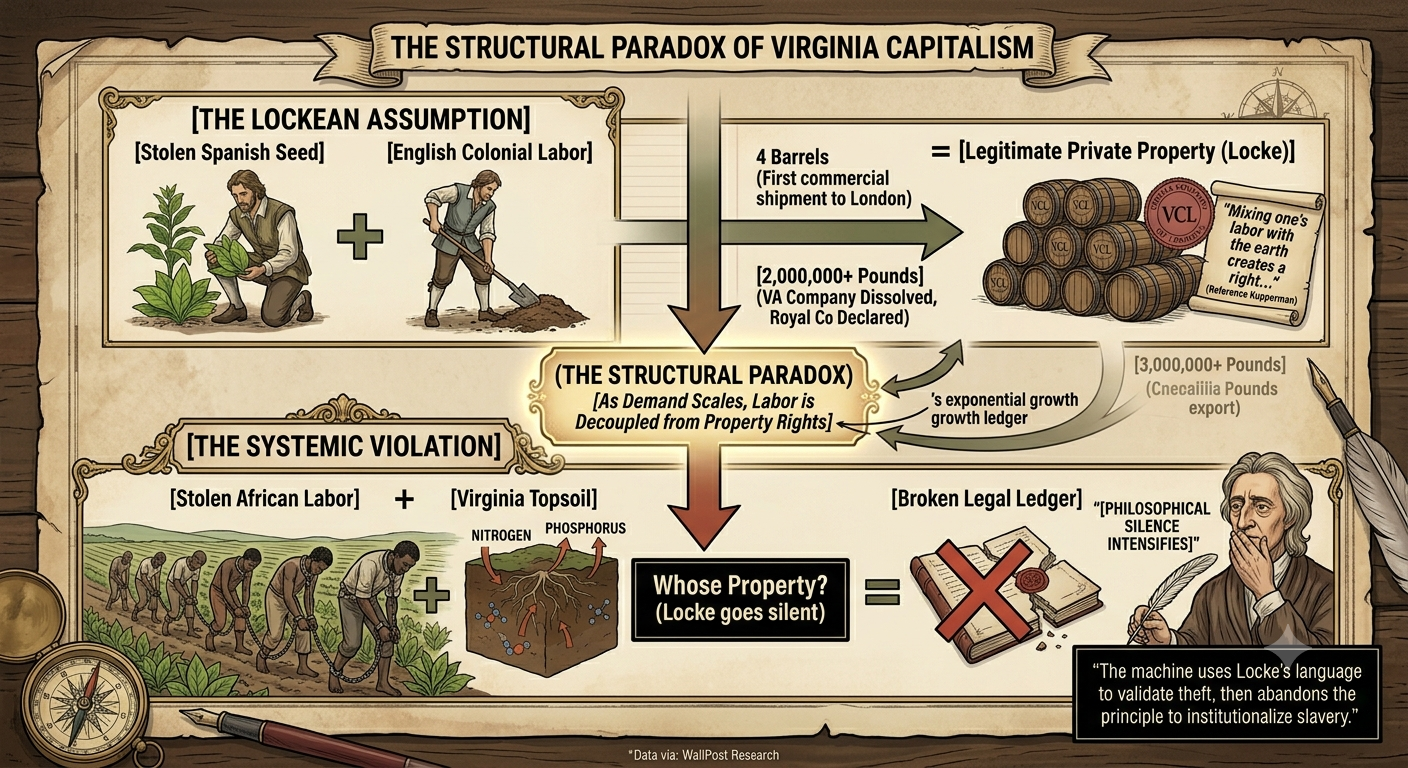
However, when this logic was scaled across the Chesapeake, it collided with its own premise. If mixing labor with the earth creates valid property rights, then the enslaved laborers who cleared the forests, turned the soil, and harvested the leaf should have held an unassailable property claim to the wealth generated.
Instead, Anglo-American law modified the Lockean framework: it defined the laborer as the property. The legal system validated the original seed theft under the guise of commercial enterprise, but suppressed the property rights of the actual labor force to preserve the profit margins of the monoculture.
VI. THE MODERN ECHO
John Rolfe's 1612 play remains the foundational blueprint for modern market disruption. The contemporary global economy is similarly governed by a recurring cycle of institutional protectionism and retaliatory corporate espionage.
- Pharmaceutical Patent Arbitrage: Modern generic manufacturers and international pharmaceutical firms routinely reverse-engineer proprietary molecular structures, file slight structural modifications to bypass existing patents, and capture emerging regional markets. This directly mirrors Rolfe modifying a Spanish biological product for English market consumption.
- Platform Feature Replication: Silicon Valley platforms regularly analyze the data, user behavior, and proprietary features of third-party developers operating within their ecosystems, replicate those functionalities natively, and shut down competition.
The Spanish Crown’s capital sanctions on seed exports represent one of the earliest state-enforced intellectual property regimes in the Atlantic world. It failed because the economic premium of the market surpassed the risk of the deterrent. Every contemporary intellectual property framework—from international copyright law to encrypted trade secrets—faces the same systemic vulnerability: the very mechanism designed to insulate a monopoly creates an equivalent financial incentive to smash it.
The structural legacy of 1612 endures. Rolfe survived, the Virginia Company collapsed into a royal takeover, and the Powhatan lost their sovereignty. The stolen seed outlived its actors, proving that in the calculus of global capitalism, the product frequently outlasts the institutional architectures that gave it birth.
PROVENANCE & PRIMARY SOURCES
- Colonial Shipping Data: Chesapeake Tobacco Export Registries (1614–1680), Colonial Office Series (CO 1/1, CO 1/21), The National Archives, Kew, UK. Contains the primary quantification of export volume leaps from four barrels to millions of pounds.
- Rolfe’s Account: Rolfe, John. A True Relation of the State of Virginia left by Sir Thomas Dale Knight in May last 1616. Pembroke MS, Library of Congress. Provides the primary narrative of early agricultural experiments and corporate motives.
- Historical Monographs:
- Morgan, Edmund S. American Slavery, American Freedom: The Ordeal of Colonial Virginia (W.W. Norton & Company, 1975). The definitive authority on the transition from indentured to enslaved labor dynamics in the Chesapeake.
- Kupperman, Karen Ordahl. The Jamestown Project (Harvard University Press, 2007). Details the structural insolvency of the Virginia Company and early political maneuvers.
- Menard, Russell R. Migrants and Motives: Atlantic Migration and the Development of the Chesapeake Labor Force, 1634–1730 (Garland Publishing, 1988). Provides the quantitative economic data establishing the cost-benefit analysis between indentured servant mortality and slave acquisitions.
- Srinivasan, Bhu. Americana: A 400-Year History of American Capitalism (Penguin Press, 2017). Framework for analyzing early colonial ventures as corporate entities.
WallPost