STOLEN LABOR BUILT THIS ECONOMY
America was not discovered. It was invoiced.
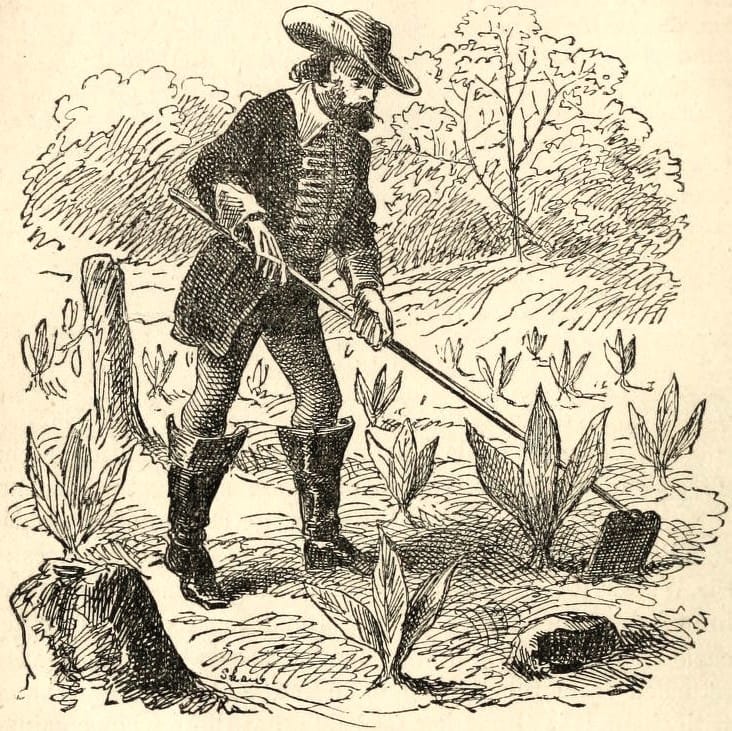
Elias stands on the dock at Point Comfort, Virginia, August 1619, watching a Dutch man-of-war drop anchor in the late summer heat. He is a tobacco planter, twenty-three years old, land-rich and labor-poor, three years into a colony that is always six weeks from starvation. He does not know he is watching the beginning of an economic system that will generate more wealth than any institution in human history — and distribute it with almost perfect inequality for the next four centuries.
The ship carries approximately twenty Africans. They are not, legally, slaves yet. That word will harden into law over the next forty years. But the tobacco is already in the ground, the English Crown already wants its cut, and Elias already knows that without bodies to work this soil, everything he has built dissolves back into the Virginia swamp.
He buys two of them.
THE MOMENT
The record is sparse by design. What survives comes from a letter written by John Rolfe — the same man who married Pocahontas and introduced commercial tobacco to Virginia — noting the arrival of "20 and odd Negroes" aboard a vessel called the White Lion at Point Comfort in late August 1619. The National Archives holds this reference. No names. No faces. No transaction amounts.
That erasure was not accidental. The economy being born in that harbor depended on the invisibility of its labor force. You cannot reconcile slavery with the dignity of personhood and run a clean ledger at the same time. So the ledger won.
The colony of Virginia was four years old, chronically underfunded, and economically precarious. The Virginia Company of London had sunk the equivalent of millions into a venture producing almost no return. Tobacco — John Rolfe's hybrid strain — had only just revealed itself as the colony's viable cash crop. The problem was scale. Tobacco is ruthlessly labor-intensive: planting, topping, worming, harvesting, curing, packing. The indentured servant system was already fraying. Contracts expired. Workers demanded land. The colony needed labor it could not lose.
The Dutch captain solved an accounting problem.
THE BIRTH
The economic logic was brutal and clear. In 1619, an indentured servant cost the planter roughly the price of passage — perhaps £6 to £10 — and worked for seven years before becoming free and then competitive. A man held in permanent bondage cost more upfront but paid back infinitely. The math required only that you were willing to treat a human being as capital equipment.
Virginia's planters were willing.
The formal legal architecture followed the economic reality, not the other way around. By 1662, Virginia law declared that the status of a child followed the mother — partus sequitur ventrem — meaning every child born to an enslaved woman was automatically property. Slavery stopped being a condition and became an inheritance. The Economic History Association estimates that by 1770, enslaved people represented the single largest capital asset class in the American colonies — larger than all land, larger than all structures, larger than all livestock combined.
The institution almost looked different. There were moments — religious debates, early Quaker dissent, individual acts of manumission — when the moral question threatened to interrupt the economic one. It never did. The tobacco economy, then the rice economy, then the cotton economy, required the answer to stay buried.
THE EMOTION
Her name is not recorded anywhere.
She arrived on a ship, worked a field, and watched Virginia become wealthy. She felt the August humidity the same way Elias felt it — as weight, as punishment, as the physical cost of existing in a place that did not want you for anything except your body's capacity to produce. She did not feel historic. She felt trapped.
History records the legislation. It does not record what it felt like to understand, sometime in the 1660s, that your children would be born into the same condition you were in — that the line between you and the future was not a door but a wall.
That feeling — that compound helplessness — is not ancient. Its economic echo is still audible in 2026.
THE CAUSE (The Chain)
Here is the mechanism, connected as it has never quite been connected before.
1619: Twenty Africans arrive. Labor problem partially solved. Tobacco profits begin to scale.
1662: Virginia codifies hereditary slavery. Labor supply becomes self-reproducing. Capital compounds.
1700s: The Atlantic slave trade industrializes. According to data compiled by the Economic History Association, approximately 400,000 Africans were brought directly to North America between 1619 and 1808, with millions more flowing through the broader Atlantic system.
1793: Eli Whitney's cotton gin makes upland cotton profitable. Demand for enslaved labor explodes southward. The domestic slave trade becomes its own industry, with Richmond and New Orleans as its financial capitals.
1800–1860: The Federal Reserve Bank of St. Louis's FRASER archive documents that by 1860, the enslaved population of the American South was valued at approximately $3.5 billion — roughly three times the value of all capital invested in American manufacturing and four times the value of all railroads. It was the largest pool of collateralized wealth in the Western Hemisphere.
1865: Emancipation destroys that asset class overnight. But the infrastructure built on top of it — the railroads, the ports, the financial instruments, the banking relationships — remains. The wealth transfers. The people who created it receive nothing.
Compound interest, applied to zero, is still zero.
THE IMPACT TODAY
The Bank of Eufaula sits in Eufaula, Alabama — cotton country, Black Belt country, land that was worked to exhaustion by enslaved people and then sharecroppers and then tenant farmers who were never permitted to own what they cultivated. This month, the Federal Reserve Board issued an enforcement action involving an employee of that bank. The action is routine. The geography is not.
The racial wealth gap tracked by FRED data at the Federal Reserve Bank of St. Louis shows Black American household median wealth at roughly one-eighth of white American household median wealth in 2024. That gap is not a cultural artifact. It is a compound interest calculation on 246 years of unrecompensed labor followed by a century of legally enforced asset denial.
Slavery no longer appears on any balance sheet. Its balance is everywhere.
THE IMPACT TOMORROW
The trajectory set in motion at Point Comfort in 1619 does not resolve itself. It accumulates. By 2076, the demographic and economic projections from the Congressional Budget Office and Census Bureau suggest America will be a majority-minority nation — and the wealth distribution patterns established in the seventeenth century will still be visible in the data unless something actively interrupts them.
No market corrects for this automatically. Markets do not have consciences. They have prices.
The unfinished accounting of 1619 is not a history problem. It is a compounding problem.
THE HUMAN IT TOUCHED
Marcus is thirty-four, works in logistics outside Birmingham, and makes $47,000 a year. He owns no property. His parents owned no property. His grandparents sharecropped. His great-grandparents were born into the generation immediately after emancipation, into a South that offered freedom without capital, citizenship without land, liberty without leverage.
Marcus has never heard of the Dutch man-of-war that docked at Point Comfort in August 1619. He has never read John Rolfe's letter. He does not think about the 1662 Virginia statute.
He just knows that money is always harder to hold than it should be, and he has never understood exactly why.
Elias bought two people and called it farming.
America built a civilization on that transaction and called it prosperity.
The bill has never been settled — and a debt that is never acknowledged does not disappear. It earns interest.
Sources: National Archives (John Rolfe letter, 1619, archives.gov); Economic History Association, "Slavery in the United States" (eh.net); Federal Reserve Bank of St. Louis FRASER Archive, antebellum economic data (fraser.stlouisfed.org); FRED, "Racial Wealth Gap Data" (fred.stlouisfed.org); Virginia Slave Codes, 1662 (Library of Congress / congress.gov legislative history context); Federal Reserve Board Enforcement Actions, June 2025 (federalreserve.gov).
WALLPOST · wallpost.org · America, through money.
© 2026 WALLPOST. All rights reserved.